C’est pour ça que l’on s’enfonce en toi
Ruben Brulat | Aleksandar Petkov
15 October – 19 December 2026
Text by Federica Barletta
Ruben Brulat and Aleksandar Petkov arrive at this exhibition from different fields of research and through different languages, yet they share an attention to what happens when matter ceases to be merely surface, object, or landscape and becomes something with which one must physically engage.
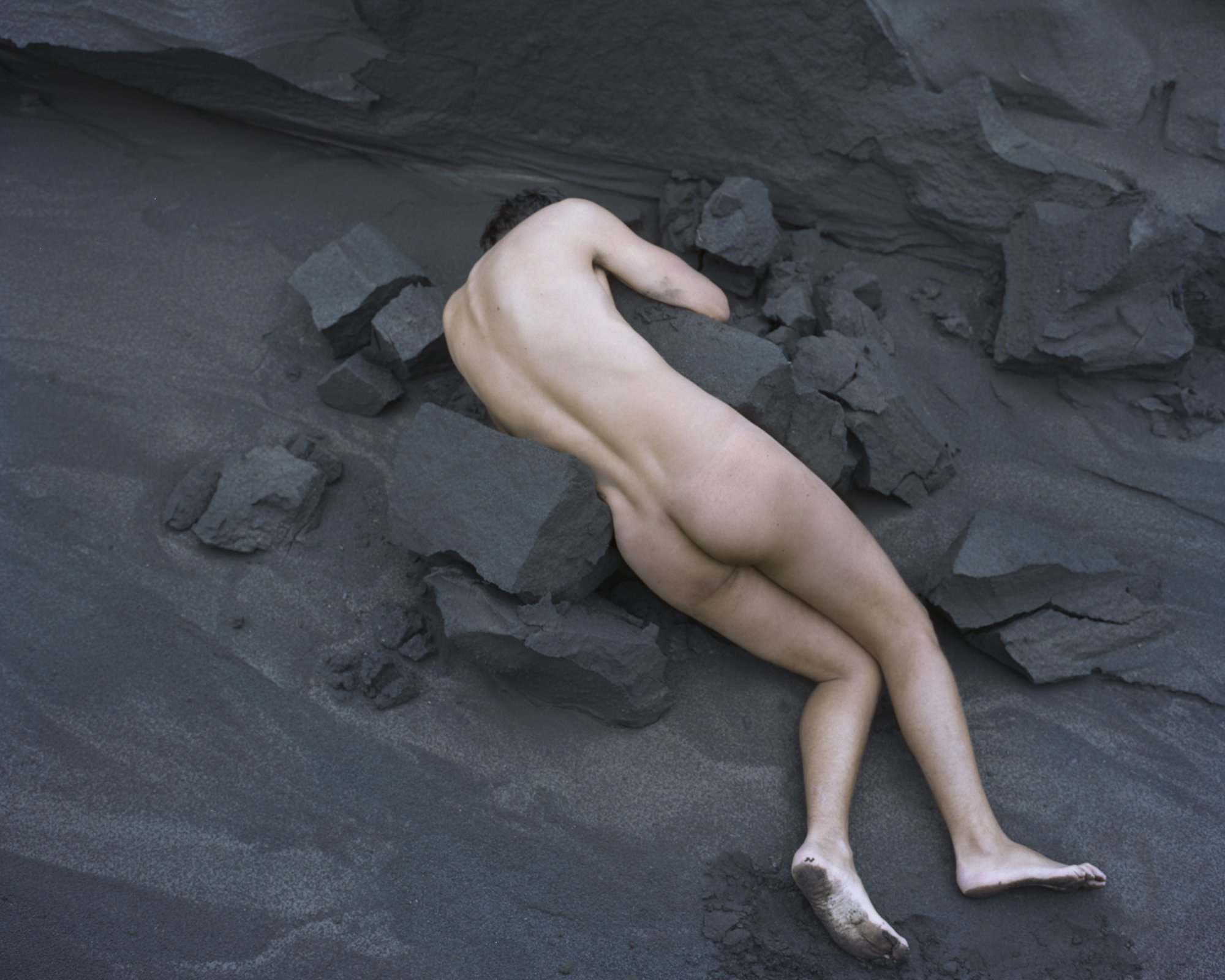
For Ruben Brulat, this relationship has long emerged through the crossing of places. In his photographs, the body appears immersed in vast territories, often difficult and almost never domesticated, taking its place within them without imposing itself. It stretches out, adheres, blends into the ground, as though the distance between figure and landscape could progressively diminish until it almost disappears.
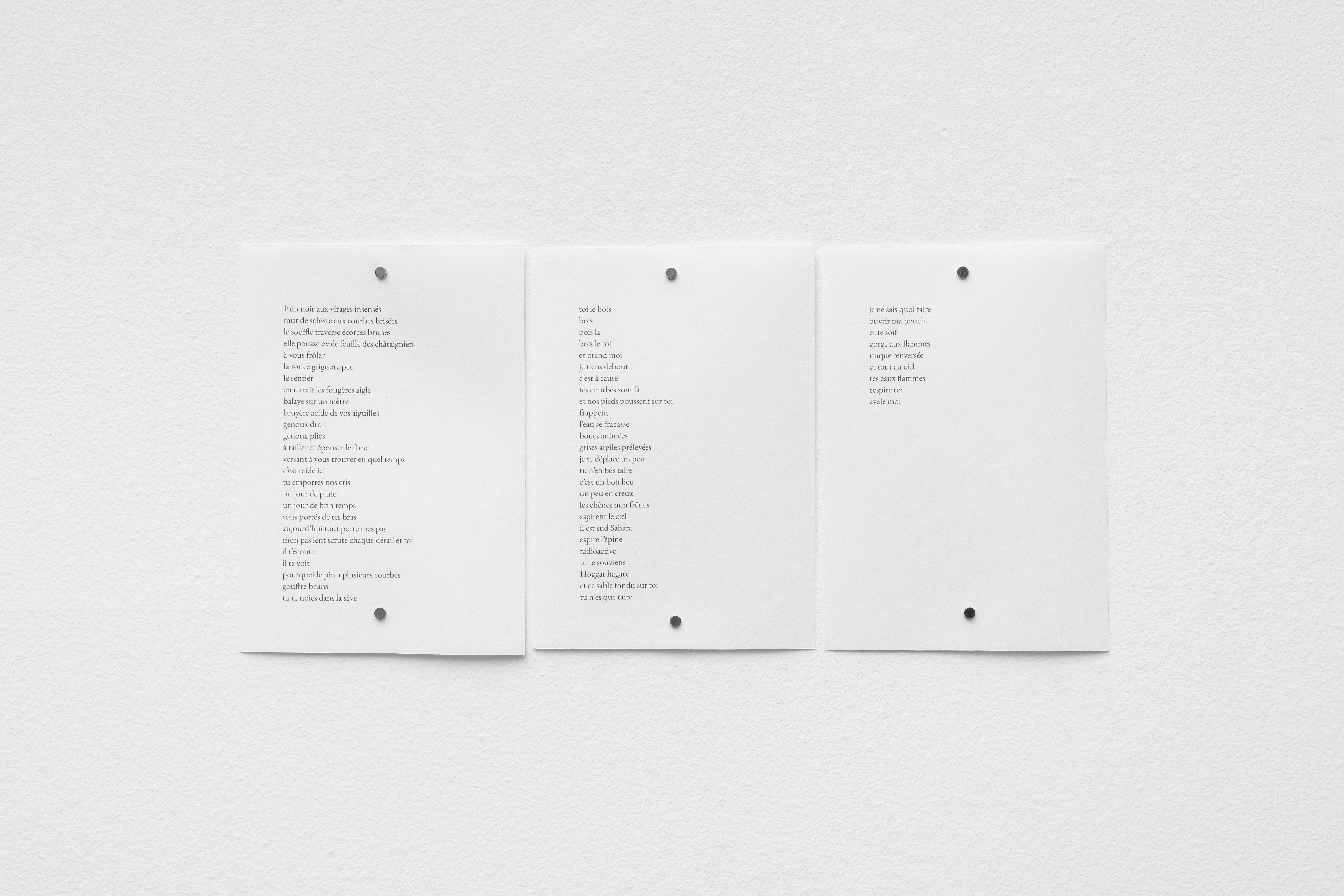
In this exhibition, the same movement continues, but changes medium. Alongside the few photographs on display, for the first time, is a body of poetry that runs across the walls of the space, almost entirely occupying them. The word thus takes the place that, in the images, belonged to the body: it passes through, rests against, returns, deviates.
In Brulat’s texts, stones, water, leaves, skin, wind, mouths, eyes, and footsteps recur. Simple elements that do not, however, construct a linear narrative, but pursue one another through associations, repetitions, and shifts. At times, even grammar seems to give way, as though language had to adapt to what it names rather than contain it. Une peau en / une peau / en une peau / en eau / en peau: only a few words are enough for skin and water to almost coincide, not only in meaning but also in sound. Elsewhere, the step returns incessantly, resting on stones, sand, water, leaves, ruins, until it loses its function as mere movement and becomes, in itself, a measure of the landscape. There seems to be no desire in these texts to describe nature from the outside. Rather, there is a desire to enter it, allowing contact itself to alter language. Un caillou ne parle pas / mais il nous parle de toi. The stone does not speak, and yet it gives something back: a presence, a memory, perhaps simply the trace of time.
It is in this passage that Aleksandar Petkov’s work comes close to Brulat’s.
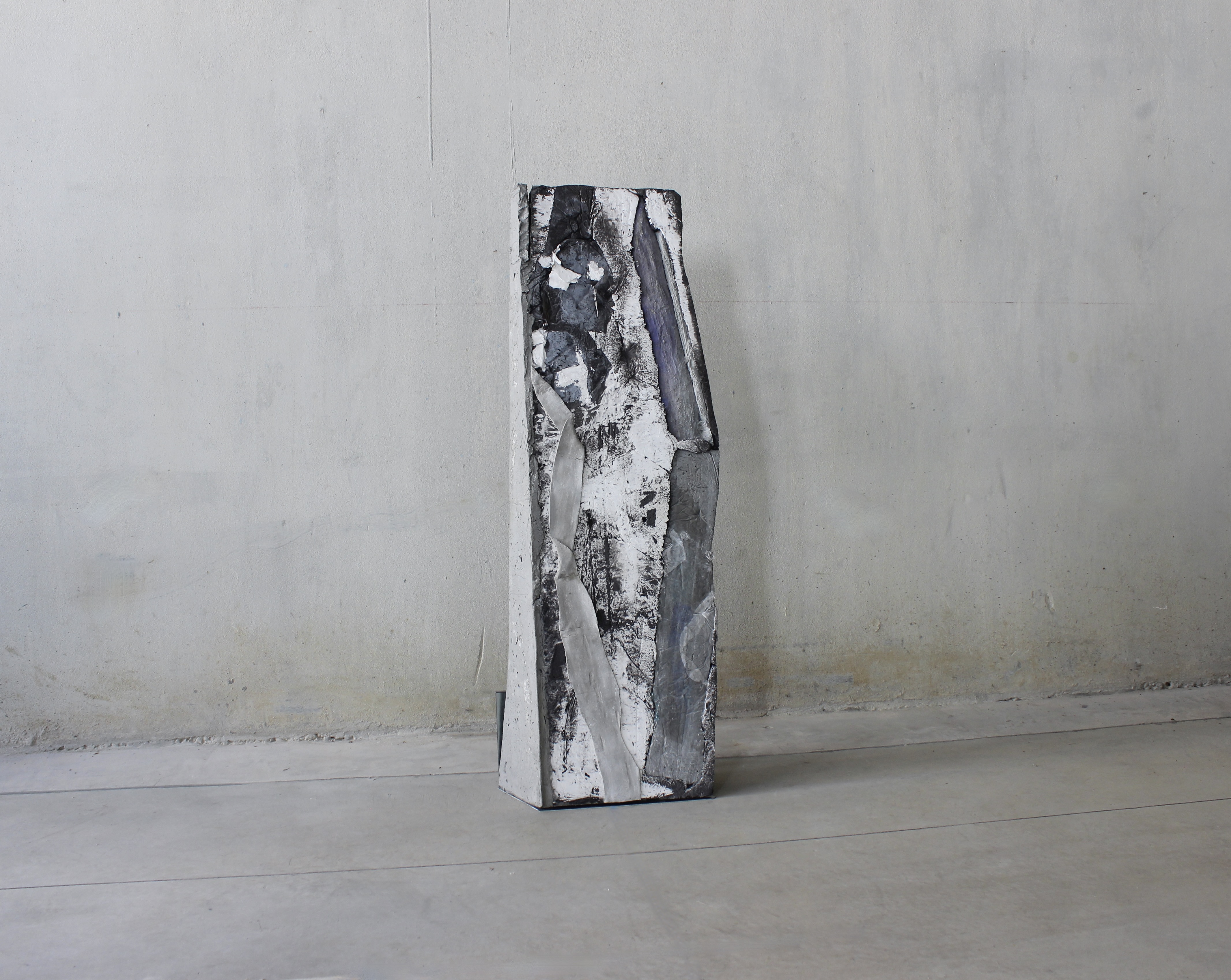
Petkov works through accumulation, layering, and the transformation of different materials, constructing forms that seem to retain the process that generated them. Nothing appears completely smoothed out or resolved: tensions, irregularities, and the points at which one material encounters another remain visible, where one rests upon, supports, contains, or contradicts the other.
His works have a distinct, almost elemental physical presence. They occupy space before they represent anything, and retain an unstable quality, as though the form they have reached were merely one of the possible moments in a process that is still open. There is always something that seems capable of shifting, tilting, giving way, or coming together again. It is a practice that proceeds through making, through a direct relationship with matter and with the limits that matter itself imposes. Petkov intervenes, adds, holds together, but without completely erasing the identity of what he uses. It is precisely this resistance that prevents the work from settling into a definitive form.
Brulat seems to do something not so different with words. He accumulates them, repeats them, shifts them, allowing one to carry the next with it and meaning to be constructed also through sound. Stone becomes mouth, skin becomes water, the step becomes a path and then almost a form of writing. The two practices thus meet not so much in a formal resemblance as in a shared attitude: working with something that cannot be completely controlled. On the one hand, a material that retains weight, roughness, and the memory of the gesture; on the other, a language that progressively relinquishes its descriptive function in order to become body, rhythm, surface in itself.
The title of the exhibition comes from one of Brulat’s texts: Regarde regarde l’eau qui boit le tout […] c’est pour ça que l’on s’enfonce en toi.
S’enfoncer means to enter, to sink, to venture further in, but it also contains the idea of a progressive loss of stability. It is a movement towards something that ultimately alters the person who makes it.
In Brulat’s photographs, this passage takes place through the body; in the poems, it enters language. In Petkov’s works, it remains imprinted in matter, in its taking shape without entirely losing what it was before.
Perhaps it is there, in that space where one thing enters another without ever being able to completely separate itself from it again, that the two practices ultimately meet.
With thanks to Galleria Studio G7, Bologna.

