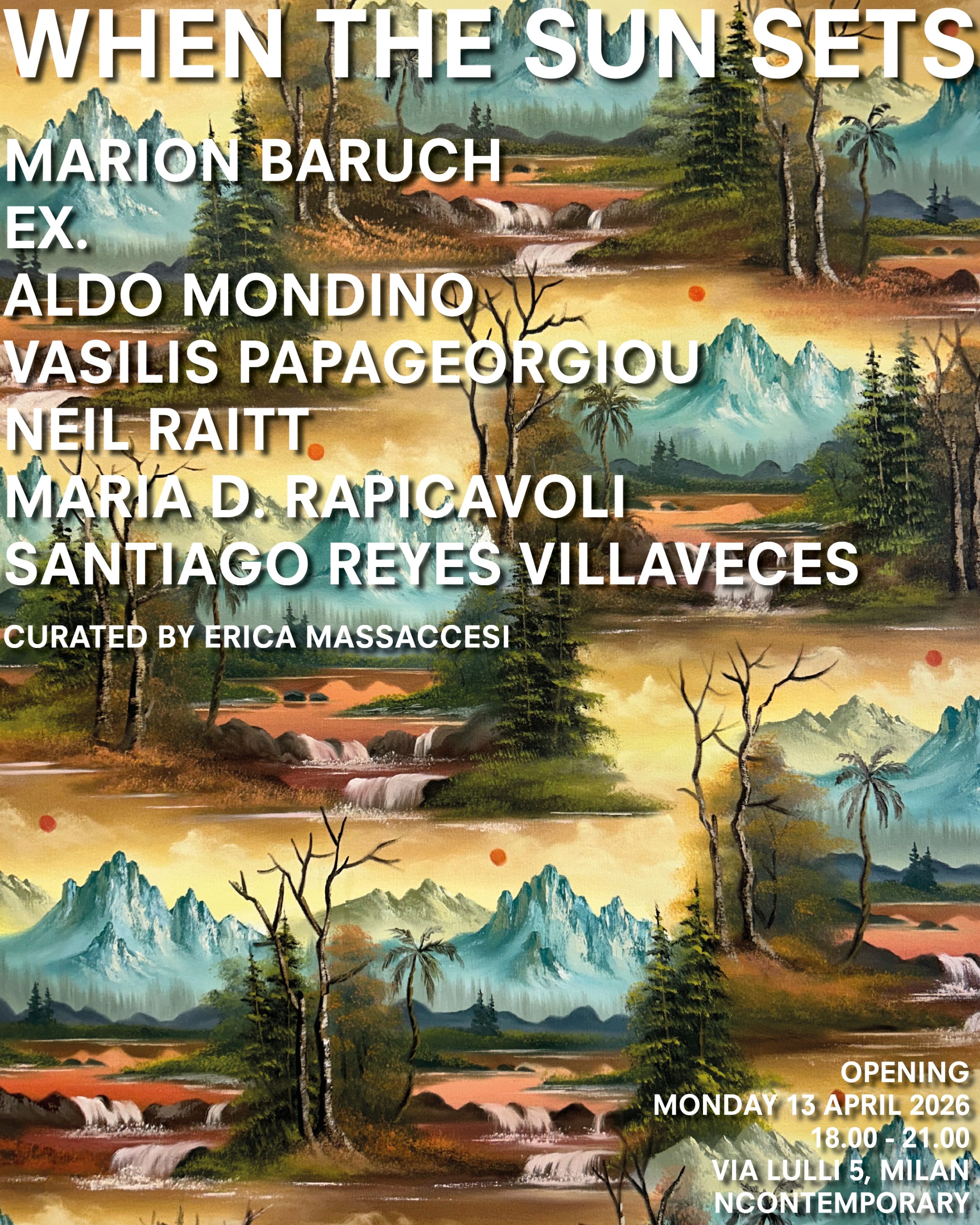
When the sun sets
Marion Baruch, EX., Aldo Mondino, Vassilis Papageorgiou, Neil Raitt, Maria D. Rapicavoli, Santiago Reyes Villaveces
Opening 13 April 2026
Ncontemporary Milan
Press Release
Ncontemporary is pleased to present “When The Sun Sets”, a group exhibition featuring works by six international artists: Marion Baruch (Romania, 1929), Aldo Mondino (Italy, 1938–2005), Vasilis Papageorgiou (Greece, 1991), Neil Raitt (United Kingdom, 1986), Maria D. Rapicavoli (Italy, 1976), Santiago Reyes Villaveces (Colombia, 1986), along with an intervention by the designer/architect collective EX. The exhibition is curated by Erica Massaccesi.
The horizon is an invisible line, yet one that is always present. It separates the earth from the sky, but it can also connect vision to imagination, a visual language to oneiric projection, the identity of the individual to alterity. The artists involved, each one with a distinct and personal expressive code, explore the horizon as a multifaceted threshold: a geographical boundary, a symbolic and liminal space, a distance between self and other, a point of tension between what is known and what lies elsewhere, between what we can reach and what remains distant, geographically, emotionally, or culturally. In the Tappeti Stesi series, Aldo Mondino reconstructs an imagined Orient through trompe-l’œil on industrial surfaces. This cycle of works is among the most renowned in his painterly-object production, initiated in the 1980s and continued through the end of the following decade. The carpet, long a symbol of hospitality and spirituality, becomes a cultural horizon: a place of encounter and exchange where different cultures blend and transform. This boundary between self and other emerges subtly yet powerfully through the use of Oriental motifs and the ambiguity of visual language. The work on view from 1986 is not a simple decorative quotation, but a conceptual device that questions our perception of cultural otherness and the limits of identity.
Pointing northward, A Starry Messenger (2019) by Maria D. Rapicavoli explicitly references Galileo Galilei’s Sidereus Nuncius, published in 1610. The treatise marks a historical moment in which astronomical observation radically transformed the horizon of human understanding by challenging the geocentric view of the universe. Rapicavoli reveals the horizon as an epistemological as well as cultural boundary, something provisional and unstable, investigating the ways in which scientific knowledge is transmitted, translated, and misunderstood. In the works of Santiago Reyes Villaveces, the horizon also emerges as a symbolic threshold, a limit between the visible and the invisible, between Earth and space, between the human and the other. In his practice, this line is never merely geographical, but a device that problematizes power relations, layers of memory, and constructions of alterity. In Plan B? (Mars) (2025), Reyes Villaveces highlights how the spatial horizon has been used to extend colonial power, expanding property rights from Earth into extraterrestrial space. Linked to a more emotional vision, the sunsets of Vasilis Papageorgiou are delicate ceramic works inspired by photographs and titled according to the exact time the sun sets on the day the work is completed.
Each piece refers to two unique moments, two unrepeatable sunsets: the one captured in the source image and the one marking the final conception of the artwork. The horizon takes shape as a fluid and multidimensional concept, no longer merely a line dividing Earth and sky, but an emotional boundary, a space where inner experience reshapes the visible world. A different interpretation of the horizon emerges in Marion Baruch’s research. In O sole mio (2023), the warmth evoked in the title refers to a concrete and everyday horizon, often associated with manual and industrial labor, a recurring theme in Baruch’s practice. It is not a threshold to be crossed, but a condition to inhabit: a warm, insistent line charged with social as well as emotional memory.
Conceived for the project room of the gallery, Neil Raitt’s site-specific project recreates a semi-nocturnal, twilight environment where mountains, trees, and skies multiply into compositions that resemble textiles more than naturalistic representations. In this context, the horizon becomes a continuous surface that challenges traditional spatial perception. It is as if the line between sky and Earth multiplies, making it impossible to distinguish where one ends and the other begins. Here, the horizon becomes abstraction, pattern, an illusion that self-replicates.
Finally, inhabiting the space are the seats created by the collective EX. and produced with ash gathered in the area surrounding Mount Etna in Sicily. A design intervention that evokes the connection between human beings and nature, the work highlights the collective’s distinctive architectural approach.
Special thanks to Galleria Umberto Benappi Turin, UNA Galleria Piacenza | Milan, and VIASATERNA Milan.
 Ncontemporary